-
Ways of being with you
Suppose you want to get in touch with your care for someone, or to feel empathy for them. One way is to imagine what it is like to be them, looking out of their eyes and feeling what they are feeling. For instance, if your friend did something frustrating, you might imagine the experience of choosing under pressure that might have led to it, and you might thereby feel warmth toward them and sympathy for their error.
But I think it is more common to do something else, kind of like imagining them from the outside, but such that their mental content is also somehow accessible.
Continue reading → -
Speaking of the efficiency of utopia
I noted that it is probably reasonable for people to be wary of things introducing themselves as ‘efficiency’, since maximization of specific metrics has some tendency to go badly.
On the other hand, ‘efficiency’ doesn’t mean anything about building explicit or quantitative machinery. It just means getting a lot of the desired output per input. So one might wonder why, if these explicit efforts would tend to make things worse for our actual goals, we would pursue efficiency in such ways, and continue to call that ‘efficiency’. For those who think quantitative pursuit of well-defined goals has been a bad strategy overall, shouldn’t ‘efficient daycare’ suggest a daycare where we have used our best intuitions for holistically improving the experience?
Continue reading → -
Covid cafes
I’m puzzled that during the pandemic so few cafes near me have moved to serving customers outside, by moving their ordering and payment apparatus to the doorway. I’ve seen about five cafes in San Francisco do this (few enough that none are conveniently close).
(I wanted to include a photo, but I actually just can’t find a picture online, such an obscure idea it is, I guess?)
Is this harder than it looks to organize? And even if it is for a small business run by a single person without a spare second all year to think about aerosols or reorganize, I’m still surprised that Starbucks doesn’t have its act together more.
Continue reading → -
Elephant seal 2
Continue reading →.jpg)
-
Feedback for learning
I wish there were better (or more known to me) quantitative tests of skills that are good for me to have. I often find learning things when there is tight feedback pretty fun. For instance, I play geography and history quizzes on Sporcle with an addictive vigor, and enjoy learning various languages on Duolingo, and various facts via Anki. I used to memorize poetry from the bathroom walls. But none of these seems that useful (in Anki I mostly learn about famous art and art movements). And meanwhile, I fail to know all manner of things that would be good to know, and forget most of what I read. (For instance, I’d like to know many more details of machine learning, how the US government works, and what happened in most of history, and I wish I remembered the details of The Precipice or The Better Angels of our Nature or even War and Peace—which I haven’t read much of, substantially because I keep losing track of what is going on or who the characters are.)
Continue reading → -
Oceans of snails
Somehow while knowing that a) ‘sea snail’ was a concept, and b) beaches were strewn with sea shells, which involve various snail-reminiscent spirals, I failed to reach the stunning conclusion that the oceans are substantially inhabited by these kinds of characters:
Continue reading → -
Play with neural net
I found Tensorflow Playground pretty cool to play with, in case anyone is looking for the kind of intuitive understanding of neural nets that futzing with a thing with one’s hands contributes to.
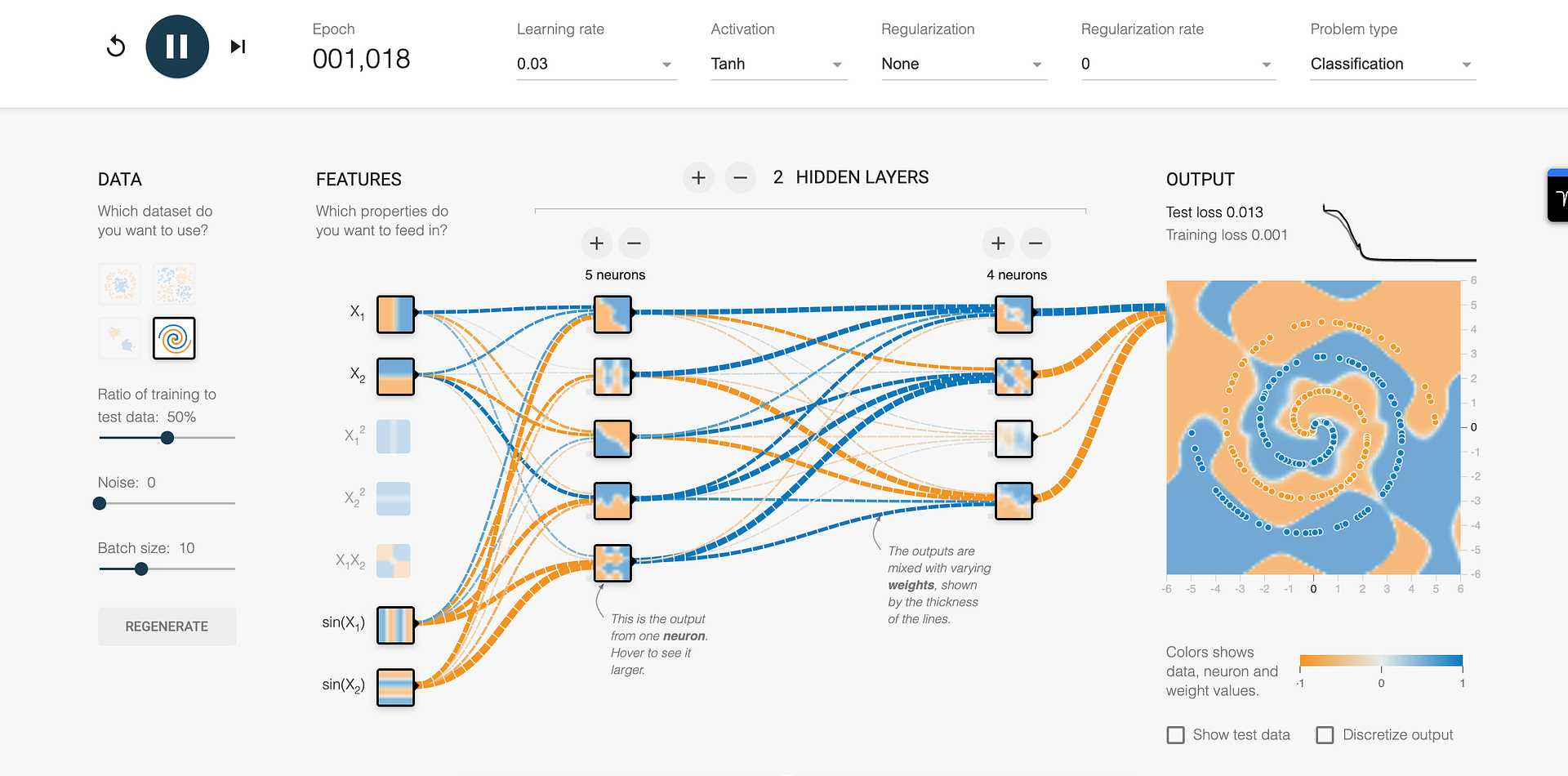
One game you can play is pretending to be a training algorithm. How would you adjust the weights, if you wanted to classify which of two spirals a point comes from?
-
Top li'l pots
I am a connoisseur of a certain genre of mostly-snack food, combining aesthetics, convenience and the idiosyncratic types of actual food that I like to eat (central examples of food whose substance I like, ignoring form, are parsley, farro, black lentils, pecans, craisins, dark chocolate, feta cheese, swedish crispbread, cream, ginger, brown or raw sugar on its own. Central non-examples are cinnabons, most cereals, cheetos, milk chocolate, cheese-flavored anything, pea protein, Coca-Cola, parmesan cheese, sweet potatos, spinach, beyond burgers.)
Here is a list of some of the best li’l pot style foods I have come across so far (not all literally in small pots). Links for illustration, not guaranteed to be value-for-money instances.
Continue reading → -
Unpopularity of efficiency
I feel like ‘efficiency’ is often scowled at. It is associated with factories and killing and commercialization, and people who are no fun. Things are openly criticized for being oriented toward efficiency. Nobody hopes to give their children an efficient childhood or asks for an efficient Valentine’s day, unless they want to get it over with. I expect wariness in listeners at talk of efficient charity.
This intrigues me, because in what I take to be its explicit definition, ‘efficiency’ is almost the definition of goodness manifest. The efficiency of a process is the rate with which it turns what you have into what you want.
Continue reading → -
What is up with spirituality?
What is up with spirituality? I mean, from an atheistic perspective?
In my experience, atheists tend to focus on the empirical question of whether there is an all-powerful supernatural creature behind all that we observe. And yeah, there probably isn’t.
But having won that point, what does one make of the extreme popularity of religion? I think the usual answer given is something like ‘well, we used to be very ignorant and not have good explanations of natural phenomena, plus we tend to see agents in everything because our agent detection software is oversensitive’.
Which might explain the question ‘Why would people think a supernatural agent controls things?’. But what seems like only a corner of religion.
Another big part of religion—and a thing that also occurs outside religion—seems to be ‘spirituality’—a cluster of things I find hard to describe, but which seem pretty disconnected from explanatory questions of where trees came from or why the crops failed.
Continue reading →
EVERYTHING — WORLDLY POSITIONS — METEUPHORIC